
 |
|---|
|
Click on Image to Enlarge |
Timeline
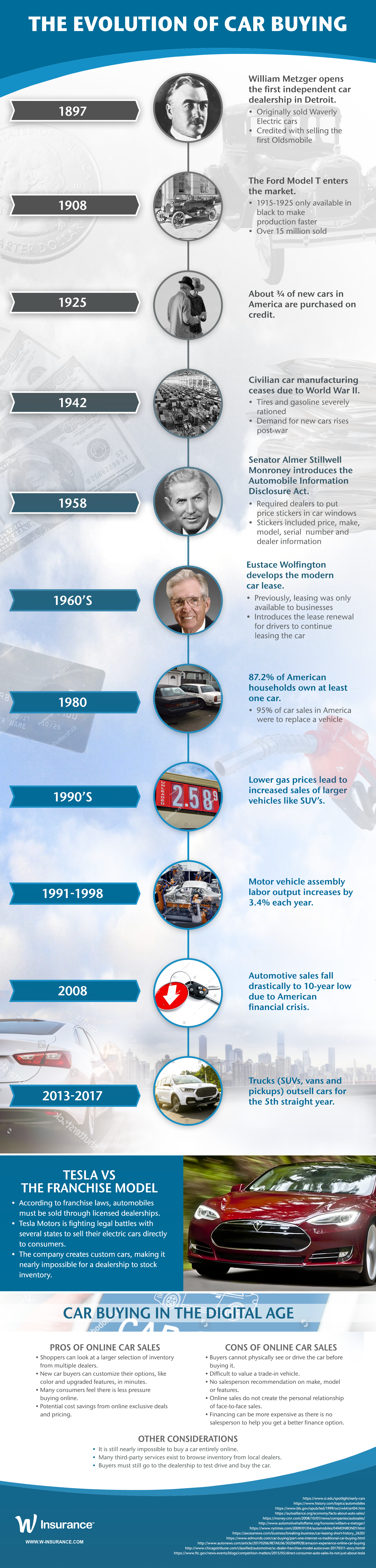
- 1897 – William Metzger opens the first independent car dealership in Detroit.
• Originally sold Waverly Electric cars
• Credited with selling the first Oldsmobile
- 1861: 1908 – The Ford Model T enters the market.
• 1915-1925 only available in black to make production faster
• Over 15 million sold
- 1925 – About ¾ of new cars in America are purchased on credit.
- 1942 – Civilian car manufacturing ceases due to World War II.
• Tires and gasoline severely rationed
• Demand for new cars rises post-war
- 1958 – Senator Almer Stillwell Monroney introduces the Automobile Information Disclosure Act.
• Required dealers to put price stickers in car windows
• Stickers included price, make, model, serial number and dealer information
- 1960’s – Eustace Wolfington develops the modern car lease.
• Previously, leasing was only available to businesses
• Introduces the lease renewal for drivers to continue leasing the car
- 1980 – 87.2% of American households own at least one car.
• 95% of car sales in America were to replace a vehicle
- 1990s – Lower gas prices lead to increased sales of larger vehicles like SUV’s.
- 1991-1998 – Motor vehicle assembly labor output increases by 3.4% each year.
- 2008 – Automotive sales fall drastically to 10-year low due to American financial crisis.
- 2013-2017 – Trucks (SUVs, vans and pickups) outsell cars for the 5th straight year.
Tesla VS the Franchise Model
- According to franchise laws, automobiles must be sold through licensed dealerships.
- Tesla Motors is fighting legal battles with several states to sell their electric cars directly to consumers.
- The company creates custom cars, making it nearly impossible for a dealership to stock inventory.
Car Buying in the Digital Age
- It is still nearly impossible to buy a car entirely online.
- Many third-party services exist to browse inventory from local dealers.
- Buyers must still go to the dealership to test drive and buy the car.
- Pros of online car sales:
• Shoppers can look at a larger selection of inventory from multiple dealers.
• New car buyers can customize their options, like color and upgraded features, in minutes.
• Many consumers feel there is less pressure buying online.
• Potential cost savings from online exclusive deals and pricing.
- Cons of online car sales:
• Buyers cannot physically see or drive the car before buying it.
• Difficult to value a trade-in vehicle.
• No salesperson recommendation on make, model or features.
• Online sales do not create the personal relationship of face-to-face sales.
• Financing can be more expensive as there is no salesperson to help you get a better finance option.